A new chapter of Barovier&Toso takes shape under the art direction of Luca Nichetto: past and present come into dialogue through the creations of Keiji Ashizawa, Emmanuel Babled, García Cumini, Studio Lani, NICHETTO®, and Claesson Koivisto Rune.

A new chapter of Barovier&Toso takes shape under the art direction of Luca Nichetto: past and present come into dialogue through the creations of Keiji Ashizawa, Emmanuel Babled, García Cumini, Studio Lani, NICHETTO®, and Claesson Koivisto Rune. An architecture of proportions, rhythm, and silences. A language that moves through tradition, generating contemporary forms.
The space opens with Etime, one of NICHETTO®’s new designs: a cubic glass volume born from the meeting of the square and the circle. Designed as a modular element, Etime combines function with sculptural presence, transforming geometry into an essential gesture. In the window display, the Profilo suspension lamp diffuses a soft, harmonious light through its discs featuring opaline spirals of varying diameters.
The Aurora table lamp completes the trio of NICHETTO® creations, reinterpreting the tradition of oil lighting in a contemporary key through an integrated technology paired with a ribbed glass body that produces delicate optical vibrations. The exhibition continues with further novelties and extensions of existing collections.
The new table and floor versions of Agave, designed by García Cumini, emphasize the collection’s vertical tension and material lightness, enhanced by the rugiada technique and a subtle gradient effect created with colored glass granules.
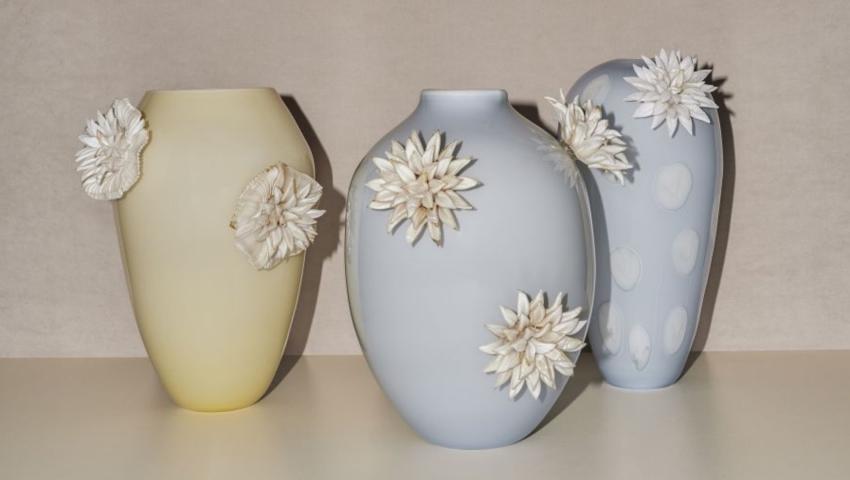
Olori, by Studio Lani, celebrates strength and femininity through a series of vases that reinterpret the layered collars of traditional African adornment in an hourglass form. With Kado, Keiji Ashizawa conceives the vase as a small architecture inspired by ikebana: articulated surfaces composed of planes and measured inclinations guide the compositional gesture, while different glassmaking techniques (from incamiciato to fine ground shading) create a delicate balance between material, color, and suspension.
The Lithos vases, designed by Emmanuel Babled, explore glass as a geological substance. A reactive mineral powder generates bubbles and inclusions that crystallize into a compact, irregular surface, evoking rock formations and fossil stratifications. Integrated optical lenses amplify the internal morphology, making each piece unique and deeply tactile.
Podio, by Claesson Koivisto Rune, introduces a modular system of vases composed of container and lid, crafted using the corteccia technique and cast glass. Their varying proportions allow for stackable compositions that evoke small architectural forms, enhancing both the flower and the vase itself as a display object, hence the name Podio.
The exhibition concludes with the Coppa Barovier, a masterpiece of the Murano Renaissance created around 1460 and traditionally attributed to Angelo Barovier. Decorated with polychrome enamels and gold on deep blue glass, it is still produced today using the original techniques, preserving a tradition that spans more than five centuries.
«With 2026 Chapter 1, we are inaugurating an important phase of renewal for Barovier&Toso, in which tradition and innovation move forward together with intention and awareness», says Andrea Signoroni. «This new chapter stems from the desire to strengthen the brand’s historic identity while making it more open, contemporary, and international. Our heritage is not merely a memory, but a living resource from which to draw inspiration for innovation.
In this sense, every product and every display is part of a coherent journey, one that reinforces the brand’s position in international markets while imagining new creative possibilities without betraying our artisanal identity».